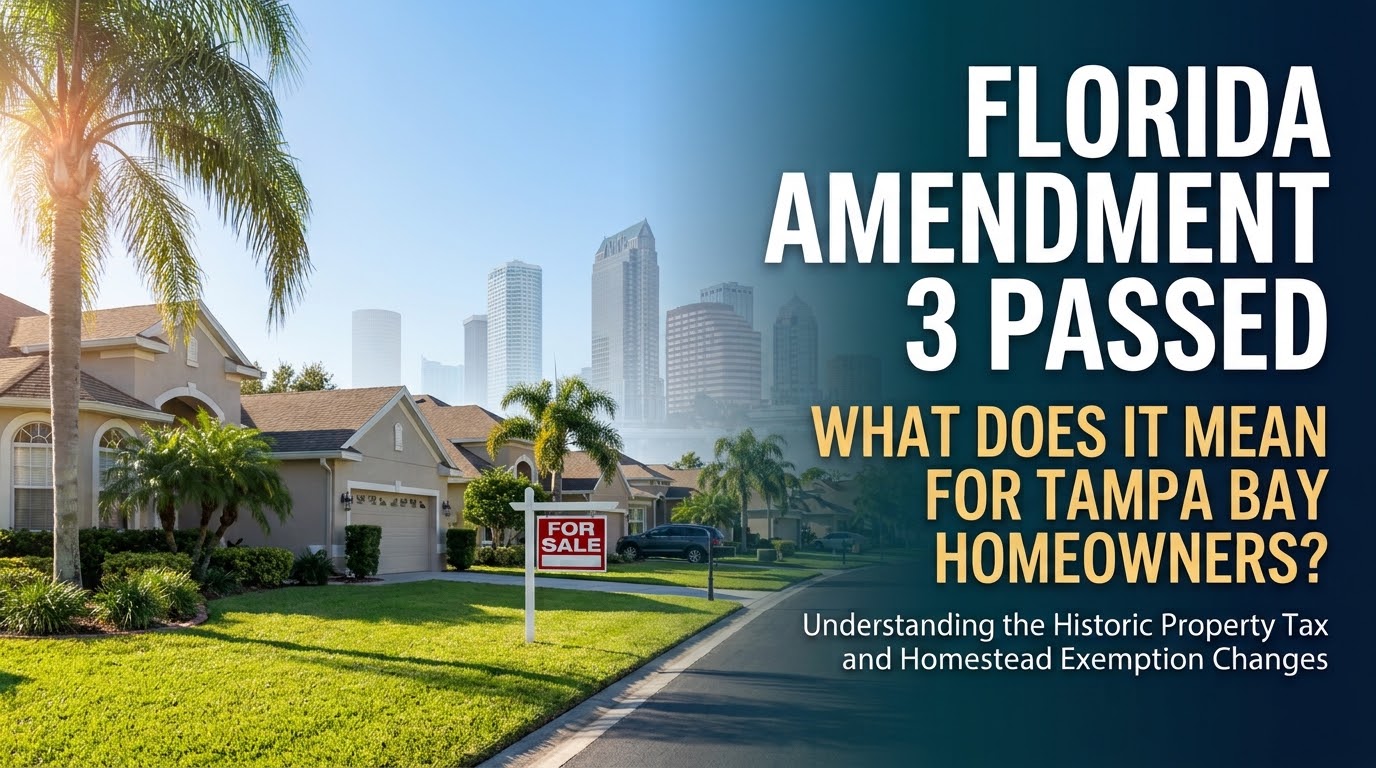
Florida voters approved Amendment 3 on November 3, 2026, with about 62% of the vote, clearing the 60% threshold a constitutional amendment needs. Most of the coverage stops at the headline: a much bigger homestead exemption. That part is true, but it's not the part that changes decisions.
What actually matters if you own, buy, rent out or sell property in Riverview, Brandon, Valrico or anywhere else in Hillsborough County is the fine print: a residency deadline that lands on December 31, 2026, a two-tier tax system that treats buyers differently depending on when they became Floridians, a tighter cap for investors that resets the moment a property sells, and a county budget hole that hits unincorporated areas the hardest.
I've been doing real estate in Tampa Bay since 2009 and I work with first-time buyers, military relocations, investors and landowners every week. Here's the plain-English breakdown, with the math, the dates, and what I'd do right now depending on where you stand.
The Short Version
- Homestead exemption on non-school taxes rises to $150,000 on January 1, 2027 and $250,000 on January 1, 2028, then adjusts for inflation.
- School taxes don't change. The $25,000 school exemption stays exactly where it is.
- Non-homestead property (rentals, second homes, vacant land, commercial) gets its annual assessment cap cut from 10% to 5%, but only for non-school taxes.
- People who weren't Florida residents on December 31, 2026 start with a $50,000 non-school exemption and step up to the larger exemption in their fifth year of homestead.
- Save Our Homes (the 3% or CPI cap on homestead assessments) and portability are unchanged.
- Your November 2026 tax bill is not affected. The first bills that reflect Amendment 3 go out in November 2027.
- Non-ad valorem assessments are untouched. CDD fees, stormwater, solid waste and similar charges can still go up.
- Cities and counties can only spend property tax money on purposes listed in the amendment, such as public safety, schools and infrastructure.
The Timeline
| When | What happens |
|---|---|
| November 2026 | Your 2026 tax bill arrives as normal. Pay it like you always do. |
| December 31, 2026 | Residency cutoff. Permanent Florida residents as of this date qualify for the full enhanced exemption. |
| January 1, 2027 | Amendment takes effect. Non-school homestead exemption becomes $150,000 for qualifying owners. |
| 2027 (date TBD) | Legislature passes implementing laws. The Governor has said he'll call a special session. |
| November 2027 | First tax bills that reflect the new exemption. |
| January 1, 2028 | Non-school homestead exemption becomes $250,000. |
| 2029 and beyond | Exemption amounts adjust annually for inflation. |
| January 1, 2030 | A county or city can shorten the five-year new-resident wait by a two-thirds vote if it finds a critical local need. |
How the Math Works on a Real Tax Bill
Your Florida property tax bill has three pieces, and Amendment 3 only touches one of them:
- School taxes. Still calculated with the existing $25,000 school exemption. No change.
- Non-school ad valorem taxes. County, city, fire, library, transit, Children's Board, water management and similar levies. This is where the bigger exemption applies.
- Non-ad valorem assessments. Flat fees and assessments like CDD, solid waste and stormwater. Not affected at all.
Here's an illustration for a long-time homesteaded owner in unincorporated Hillsborough (Riverview, Brandon, Valrico and similar areas). It uses the actual 2026 non-school millage for unincorporated Hillsborough, taken straight from a 2026 tax bill: 11.91 mills. That covers county operating, the unincorporated-area MSTU, library, environmental lands, Port Tampa Bay, HART, the Children's Board and the Southwest Florida Water Management District, out of an 18.244-mill total. The other 6.334 mills are school taxes, which Amendment 3 doesn't touch. Inside Tampa, Temple Terrace or Plant City your rate is different. Your exact rates are printed on your TRIM notice every August and on your November tax bill. (For the backstory on why Hillsborough bills jumped last year, see my post on Hillsborough County's largest property tax increase in years.)
| 2026 (current law) | 2027 | 2028 | |
|---|---|---|---|
| Save Our Homes assessed value | $280,000 | $280,000* | $280,000* |
| Non-school homestead exemption | $51,411 | $150,000 | $250,000 |
| Non-school taxable value | $228,589 | $130,000 | $30,000 |
| Non-school taxes at 11.91 mills | $2,722 | $1,548 | $357 |
*Assessed value will actually creep up by up to 3% a year under Save Our Homes. I held it flat to make the comparison clean.
That's roughly $2,365 a year less in non-school taxes by 2028 in this example. The school portion and any CDD or other assessments stay on the bill, which is why almost nobody's bill goes to zero. On a sample 2026 Riverview bill, the non-ad valorem charges alone (solid waste, stormwater, water and sewer) added about $918 on top of the property taxes.
One caveat worth saying out loud: this assumes millage rates stay put. Local governments set rates every year, and some may raise them or add fees to cover lost revenue. More on that below.
The December 31, 2026 Deadline Is About Residency, Not Your Closing Date
This is the piece I think gets misunderstood the most, and it's the one with a clock on it.
The enhanced exemption goes to people who maintained a permanent residence in Florida as of December 31, 2026 and qualify for homestead. Anyone who becomes a Florida resident after that starts with a $50,000 non-school exemption (indexed to inflation starting in 2028). After keeping a Florida homestead exemption for four years, they get the larger exemption beginning January 1 of the fifth year.
What that means in practice:
If you already live in Florida and rent, you're on the full track. You don't need to buy a home by December 31. When you do buy and homestead later, you qualify for the enhanced exemption on the same schedule as existing owners. For a lot of first-time buyers I work with in Riverview and Brandon, this is the best news in the whole amendment, especially when it's paired with down payment help like the Florida Hometown Heroes program.
If you're moving to Tampa Bay, the date that matters is when you become a permanent resident, not when you close. Someone who genuinely relocates in December and rents first is in a very different spot than someone who moves in February. Rushing into the wrong house to beat a deadline is a bad trade. Establishing real residency, then shopping carefully, may be the smarter move.
This is not a paperwork trick. The amendment relies on Florida's existing concept of permanent residence, and attorneys reviewing it have warned that December 31 shouldn't be treated as a simple filing deadline. The usual evidence of Florida residency includes a Florida driver's license, Florida vehicle registration, voter registration and, for some people, a Declaration of Domicile filed with the Clerk of Court. Exactly how the state will verify residency as of December 31 hasn't been spelled out yet; that's coming in implementing legislation. If your situation is borderline, talk to a tax professional before you count on the bigger number.
If you bought in 2026 and moved in, file for homestead. The standard filing deadline is March 1. Missing it means waiting another year.
Military Relocations to MacDill: Read This Before You Budget
I haven't found any military-specific carve-out in Amendment 3, and the official summaries from county property appraisers don't mention one.
That matters because service members often keep their legal residence in their home-of-record state while stationed elsewhere. Under existing Florida law and past Attorney General guidance, a service member's residency for homestead purposes generally follows where they were a permanent resident when they entered service.
So a few scenarios:
- Florida was already your legal home of record and you're coming back: you may already count as a permanent Florida resident. Confirm it.
- You're PCSing to MacDill from another state in 2027 and plan to make Florida your legal residence: expect to be on the new-resident track (the $50,000 exemption for the first four years) unless implementing legislation changes something.
- You're keeping your home-of-record state while stationed here: you generally won't be homesteading in Florida in the first place.
Before you build a tax number into a VA loan budget, call the Hillsborough County Property Appraiser's office with your specific situation. And if you're arriving before year-end with orders in hand, that's worth a conversation now.
For Buyers: The Tax Number on the Listing Is Even Less Useful Now
The property taxes shown on a listing have always been the seller's taxes, not yours. When you buy, the assessed value resets to market value and the seller's Save Our Homes savings disappear. Amendment 3 makes that gap bigger, and it adds a second gap based on when you became a Floridian.
Same house, same street, two different buyers in 2028:
| $450,000 purchase in 2028, unincorporated Hillsborough | Buyer A: Florida resident before Dec. 31, 2026 | Buyer B: Moved to Florida in 2027 |
|---|---|---|
| Non-school exemption | $250,000 | About $50,000 |
| Non-school taxable value | $200,000 | About $400,000 |
| Non-school taxes at 11.91 mills | $2,382 | About $4,764 |
| School taxes | Same | Same |
That's about $2,380 a year apart on the non-school portion, for the same house, until Buyer B reaches their fifth year. Meanwhile the long-time seller in my earlier example might be paying around $357 in non-school taxes. Three people, one house, three very different bills.
If you're shopping, budget with the number that applies to you. My real-world affordability guide walks through the full monthly picture, and in newer communities, don't forget that CDD fees sit outside Amendment 3 entirely.
Will home prices go up?
Maybe some, over time. A 2025 Realtor.com analysis suggested Florida home values could rise 7% to 9% if property taxes were eliminated outright. Amendment 3 doesn't go that far, and Florida Realtors has said it isn't convinced values will jump quickly.
My take: lower carrying costs for in-state buyers will get partly priced in, especially in the price ranges where the $250,000 exemption covers most of a home's assessed value. But insurance, interest rates and inventory still move Tampa Bay prices more than this will. I wouldn't buy or wait based on a price-bump prediction.
For Sellers: Selling Doesn't Cost You the New Exemption
The enhanced exemption is tied to you being a Florida resident as of December 31, 2026, not to the specific house you own. If you're a long-time Floridian thinking about selling and buying your next home here, you keep your eligibility. Save Our Homes portability also works the same way it did before, so you can still carry some of your built-up savings to the next home.
Two things I'd think about when pricing and marketing:
- Your buyer pool now has two tax profiles. In-state buyers will see lower carrying costs than out-of-state buyers for the first four years. Depending on your price point, in-state move-up and first-time buyers may be your strongest audience.
- Don't advertise your tax bill as the buyer's tax bill. That's always been bad practice, and now it can be off by thousands. If you want a real number for a buyer, we can estimate it based on their situation.
If you want to see what you'd walk away with, my seller closing cost calculator is a good starting point.
For Investors, Landlords, Land and Small Commercial Owners
Non-homestead owners don't get the bigger exemption. They get the lower cap. Here's what that actually means:
- The 5% cap only applies to non-school taxes. School taxes on non-homestead property are still based on full market value with no cap.
- A cap limits assessed value growth, not tax rates. If your county or city raises millage to make up for lost homestead revenue, a non-homestead property absorbs that increase with no exemption to soften it.
- The cap resets when the property sells. A tighter cap builds a bigger gap between assessed and market value over time, which means a bigger jump for the next buyer. Model your post-closing taxes on market value, not on the seller's current bill.
- LLC and entity transfers count too. A cumulative change of more than 50% of ownership or control triggers reassessment. Owners are supposed to notify the property appraiser of unrecorded changes, and failing to can bring a lien, 15% annual interest and a penalty of 50% of the taxes avoided.
- Rents may feel it. The Leon County judge who ordered the ballot language rewritten noted that renters will likely pay more if landlords pass along higher millage. For my property management clients, I'd budget conservatively on tax lines for 2027 and 2028 rather than assuming savings.
- Vacant land holders get somewhat slower growth in non-school assessments, which helps holding costs at the margin. Same caveats on millage apply.
If you're under contract on an investment property or a small commercial building right now, rerun the numbers with a realistic post-closing tax estimate.
What It Means for Hillsborough County (and Why Riverview and Brandon Should Pay Attention)
Riverview, Brandon, Valrico, Lithia, Seffner and much of the Tampa Bay suburbs are unincorporated. There's no city government. Hillsborough County is effectively your city, so county budget decisions show up directly in your services and fees. More than 1.08 million people, about 69% of the county's population, live in unincorporated Hillsborough.
Here's what local officials have said, based on their own estimates before the vote:
- Hillsborough County staff estimated a loss of about $367 million a year in county property tax revenue, money that mostly funds the sheriff, fire rescue, transportation, emergency management and parks.
- Longer-range projections put Hillsborough's loss at nearly $702 million a year by 2032.
- County staff floated options including drawing on reserves, hiring and pay freezes, program cuts, and new or higher taxes and fees, such as an additional five-cent fuel tax and higher park fees.
- The City of Tampa estimated a hit of $35 million to $40 million in fiscal year 2028. Mayor Jane Castor has said services will continue, but with fees attached.
- HART warned it may have to eliminate six bus routes.
- The Children's Board of Hillsborough County could see cuts of around $20 million.
- Commissioners approved a workshop early next year to start planning for the next budget cycle.
On the other side, supporters point out that local property tax collections grew fast during the run-up in values, and argue the warnings are overstated. Both of these things can be true at once, and we'll find out which way it tilts when the 2027 budget gets written.
One detail people miss: school funding isn't part of this. School taxes keep the existing exemption, and on the same ballot Hillsborough voters extended the school district's half-cent sales tax for capital improvements.
What I'd watch: county budget workshops in early and mid 2027, proposed fee changes, and your TRIM notice in August 2027. That notice will be the first time you see your actual 2027 numbers.
Who Supported It and Who Opposed It
Amendment 3 was a priority for Governor Ron DeSantis, who pushed the Legislature to put it on the ballot during a June 2026 special session. The Republican Party of Florida backed it, and so did Florida Realtors, which I'm a member of. Supporters argued that homeowners need relief as the cost of keeping a home keeps climbing.
Opponents included the Florida Sheriffs Association, police and firefighter groups, Florida TaxWatch, the Florida League of Cities and the Florida Democratic Party. Their argument: it shifts the tax burden onto renters, businesses, newcomers and non-homestead owners, and forces cuts to local services.
I'm not here to relitigate the vote. It passed. The useful question now is how to make good decisions under the new rules.
What's Still Unknown
- Implementing legislation. The Legislature still has to pass the laws that handle administration, including how residency as of December 31, 2026 gets verified.
- The new-resident rule may be tested. The amendment applies the five-year rule "to the extent permitted by the U.S. Constitution." That's lawyer language, and it's worth watching.
- Local option to go further. The Legislature must create a process letting counties and cities raise the exemption up to a home's full assessed value for their own levies. There's no requirement or timeline for any local government to use it.
- Local budgets. Millage rates, fees and service levels for 2027 and beyond haven't been set.
I'll update this post as those details come out.
What I'd Do Right Now, Based on Your Situation
- You own a homesteaded home: Nothing to file. Existing homestead owners don't need to reapply. Pay your November 2026 bill as usual (paying in November still gets you the biggest early-payment discount), and watch your August 2027 TRIM notice.
- You rent in Florida and want to buy: You're already on the full track. Keep your Florida license, registration and voter info current, and buy on your own timeline, not a deadline.
- You're moving to Tampa Bay soon: If the move is real and happening anyway, becoming a permanent resident before December 31, 2026 could be worth thousands over your first four years. Rent first if you need to. Talk to a tax pro if anything about your residency is borderline.
- You're PCSing to MacDill: Confirm your residency status with the property appraiser before you lock in a budget.
- You bought in 2026: File for homestead by March 1, 2027.
- You own rentals, land or commercial property: Rerun your numbers assuming flat or higher millage, not savings. If you're buying, underwrite taxes on market value.
- You're selling: Price and market with the right buyer in mind, and never present your tax bill as theirs.
Amendment 3 FAQ
Did Florida Amendment 3 pass?
Yes. It passed on November 3, 2026, with about 62% of the vote, above the 60% required.
Does Amendment 3 eliminate property taxes?
No. It raises the homestead exemption on non-school taxes. School taxes and non-ad valorem assessments like CDD fees stay on your bill.
When will I see the savings?
On your November 2027 tax bill, with a bigger step on the November 2028 bill. Your November 2026 bill isn't affected.
Do I need to reapply for my homestead exemption?
No. Existing homestead owners don't need to file anything new.
Does Amendment 3 change school taxes?
No. The $25,000 school exemption stays the same.
I'm moving to Florida in 2027. What exemption do I get?
You'd start with a $50,000 non-school exemption (adjusted for inflation starting in 2028) plus the standard $25,000 school exemption and Save Our Homes protection. The larger exemption kicks in beginning your fifth year of homestead.
I rent in Florida now. Do I qualify for the bigger exemption when I buy?
If you're a permanent Florida resident as of December 31, 2026, yes. You'd get the enhanced exemption once you buy and qualify for homestead.
Does Amendment 3 help landlords or renters?
Non-homestead property gets a lower 5% cap on non-school assessment increases, but no exemption. Rental owners could still see higher taxes if local millage rates rise, and some of that may reach renters.
Does Amendment 3 affect CDD fees?
No. CDD fees and other non-ad valorem assessments aren't affected.
Want Your Actual Numbers?
Every situation here comes down to three things: when you became a Florida resident, what kind of property you own or want, and where it sits in Hillsborough or Pasco. If you want me to run the numbers on a home you own, one you're looking at, or a rental you're underwriting, call or text me at (813) 857-1543 or send me a message. If you're already working with someone and want a second opinion, I'm happy to look.
This post is general information based on what was publicly available as of November 4, 2026, and isn't tax or legal advice. Implementing legislation may change how parts of Amendment 3 work. For your specific property, check with the Hillsborough County Property Appraiser or a qualified tax professional.