The Zillow Toll: How the “Flex” Program Quietly Makes Home Buying More Expensive
Over the last year, the real estate industry has been turned upside down by the NAR settlement. Buyers are now expected to pay their own agent’s commission — something that was traditionally covered by the seller. That shift alone makes transparency and affordability more important than ever.
But while buyers are still adjusting to these changes, Zillow has found a new way to make the process even more expensive — through its so-called “Zillow Flex” program.
What Zillow Flex Really Is
Zillow Flex is marketed as a “no-upfront-cost” program for agents: Zillow sends buyer leads to certain “Flex Partner Agents,” and when a deal closes, Zillow takes a referral fee that can reach 40% of the agent’s commission.
On the surface, Zillow frames this as a pay-for-performance model. In reality, it’s a steep hidden fee that ultimately shifts costs back onto home buyers because of the recent changes with NAR.
Here’s why:
- Under the new NAR settlement, buyers must sign a written buyer-broker agreement before touring homes. It must clearly outline the agent’s compensation, state that commissions are negotiable, and prohibit the agent from collecting more than the agreed amount from any source. (Sellers can still pay your agent directly, and most still do.)
- So when Zillow charges that agent a 40% cut, it effectively means Zillow is charging the buyer for the privilege of using Zillow’s referral system.
- Zillow keeps that money — not the agent who actually does the work, and not the buyer who’s footing the bill.
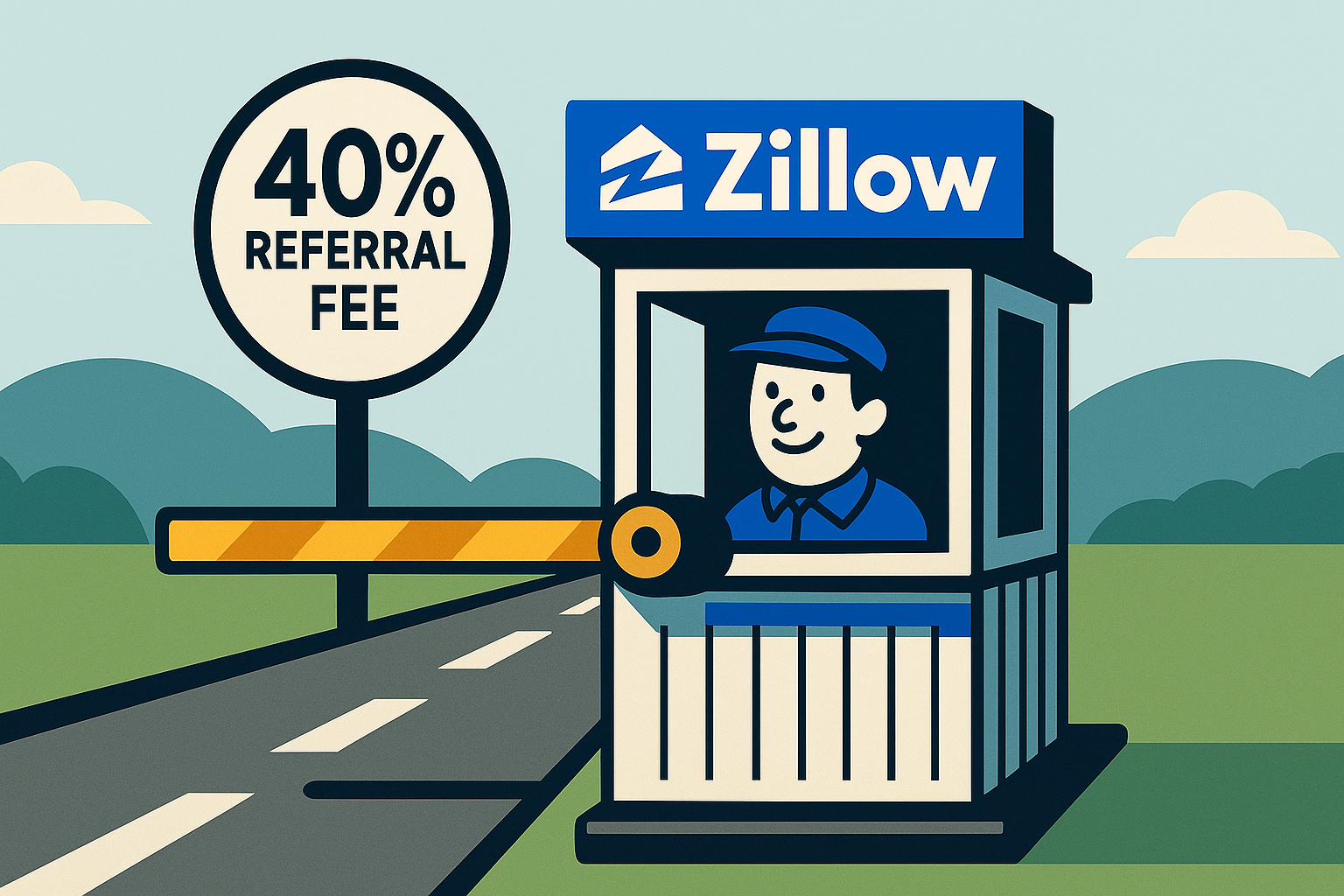
That’s not innovation. That’s a toll booth.
Why This Matters to Every Buyer
Zillow markets to consumers by positioning itself as a free, data-rich “housing super app” that simplifies the entire home journey, from dreaming to buying or selling. Their primary service “connects you with a great local agent.”
But what Zillow doesn’t advertise is how this arrangement strips buyers of negotiating power and inflates transaction costs.
- Your agent can’t freely negotiate their fee. Since a huge portion of their commission goes straight to Zillow, the Flex agent has little flexibility to lower costs for you. In many cases, a Flex agent’s take-home pay after Zillow’s cut and broker fees is 30-40% of the total commission — leaving no room to offer you savings or rebates.
- The “free lead” isn’t free — it’s baked into your price. When a buyer’s agent has to pay 40% of their earnings to Zillow, that cost doesn’t disappear. It either reduces the agent’s ability to negotiate hard on your behalf — or it quietly gets rolled into the transaction through higher total commissions.
- You may not even realize who you’re contacting. When you click “Contact Agent” on a Zillow listing, you’re usually not reaching the listing agent. You’re routed to one of Zillow’s “Flex Partner” agents — someone paying to get that lead. That’s not inherently bad — but it’s rarely disclosed or understood. And in today’s transparent-fee environment, that lack of disclosure is a serious problem.
- Pressure to steer buyers toward Zillow Home Loans. There are reports that Zillow Flex agents are strongly encouraged, or even required, to direct a percentage of their clients to Zillow Home Loans for pre-approvals. Agents who fail to do so reportedly risk reduced lead flow or removal from the Flex program altogether.
That means your agent’s recommendations might be influenced by corporate requirements, not your best interests.
Let’s Call It What It Is
Zillow has turned its website into an online toll road — every “Request a Showing” button, every lead, every click is another way to collect a fee for simply using the platform.
That 40% “success fee” might have seemed harmless when sellers paid the buyer’s agent commission. But now that buyers are footing that bill, Zillow’s Flex model has effectively become a buyer-paid surcharge for accessing its site.
Each time a buyer uses Zillow’s tools to find an agent, they’re passing through Zillow’s digital toll booth, where a 40% cut is taken before the agent even gets paid.
And here’s the kicker: none of that money enhances your home-buying experience. It doesn’t improve service quality, speed, or results — it just feeds a corporate referral system that profits from standing between you and your agent.
This isn’t innovation. It’s an online toll disguised as convenience.
What Buyers Should Do Instead
Here’s how you can protect yourself and your wallet:
- Work directly with a local agent you trust — not an anonymous “Flex Partner” assigned through an algorithm.
- Ask whether your agent is part of a referral program and how much of their commission goes to Zillow or another platform. (Zillow isn’t the only company doing this; they’re just the largest player.)
- Negotiate fees up front. A transparent local Realtor should be able to show you exactly what you’re paying and why.
- Don’t assume Zillow is the only path. You can contact a listing agent or trusted buyer’s agent directly, without paying a hidden referral fee. The listing agent and broker’s contact information is located above the map on each Zillow listing. You can also contact listing agents directly by searching on homes.com.
The Bottom Line
Zillow Flex isn’t helping affordability — it’s adding a new layer of cost at a time when buyers can least afford it. In a post-NAR-settlement world where transparency is supposed to be the new standard, buyers deserve clear disclosure about where their money is going — and Zillow owes them that honesty.
Now, even lawsuits have started to surface alleging that Zillow’s Flex program misleads consumers and pressures agents into practices that benefit the platform, not the buyer. According to a USA Today report, a class-action lawsuit alleges that Zillow has hidden agent fees in its Flex program — taking large referral cuts from agents without clearly disclosing the impact to buyers.
As a local Realtor and advocate for change, I believe these referral fees and obligations should never be buried in fine print or hidden inside a terms-of-service that nobody reads. Homebuyers deserve upfront clarity — not digital tolls and hidden costs disguised as innovation.
If you’re buying in the Tampa Bay area and want a clear, straightforward breakdown of how commissions really work—with no referral fees, no middlemen, and no surprises—reach out anytime. I’ll walk you through your options so you can make confident, cost-smart decisions.

